Avernum: My Childhood RPG
May 4 2021
When I was growing up, my father had a big, beige Macintosh computer running MacOS 9. Entertainment options on this computer were mostly shareware demos of Spiderweb Software games. Nethergate, Geneforge, and Avernum provided me with many hours of enjoyment as a kid. It was many years until I played any other role-playing game and this very strongly colored the way I saw all subsequent RPGs. With such hazily positive memories I don’t know if the rarity of different games living up to the example set by Spiderweb Software is realistic. In my mind, Avernum is an excellent video game. In my mind, Avernum is the distilled essence of what it means to be a computer role-playing game. It is peak RPG. But is it?
To help answer this question and to organize my thoughts, I have split my notes into several sections. I’ll overview how the game runs and provide some basic narrative information, I will list some of the things I particularly liked and disliked, and I will discuss some specific concerns related to the way I am running my playthrough. This play through will involve using a party of one, and only go as far as completing one of the three available main quests. I strive to minimize spoilers because I would like more people to play this game.
What is Avernum?
The setting of Avernum is quite unique to the franchise. It does not seem to pull too heavily from the standard sources but is a standalone universe. It is rich, internally consistent, and serves as an excellent canvas on which to paint the many stories of Avernum. In broad strokes, there is the Surface, and there is Avernum. The Surface, as the name implies, is bright sunshine, fat cows, and golden tanned skin. Avernum, by contrast, is the deep dark underground where the misfits of the Surface are exiled to scratch out a meager living from the fungus encrusted rock of the extensive cave system.
On a technical level, Avernum, and the Avernum engine, is a party-based, axonometric, turn by turn role playing game set within a fantasy earthlike realm. It has, from today’s perspective, very low hardware requirements. It successfully runs on an 800 MHz Intel A110 and the whole game fits within 27 megabytes. It is low resolution, fitting within 800x600 pixels. It very much is a masterpiece of efficiency. The graphical quality is primitive, but fantastic. The word ‘concise’ comes to mind. Each sprite communicates so much, and does so unambiguously. A cat is a cat. A goblin, a goblin. Trees are obviously trees. There is no muddy brown and green mess on your screen that is so common today.
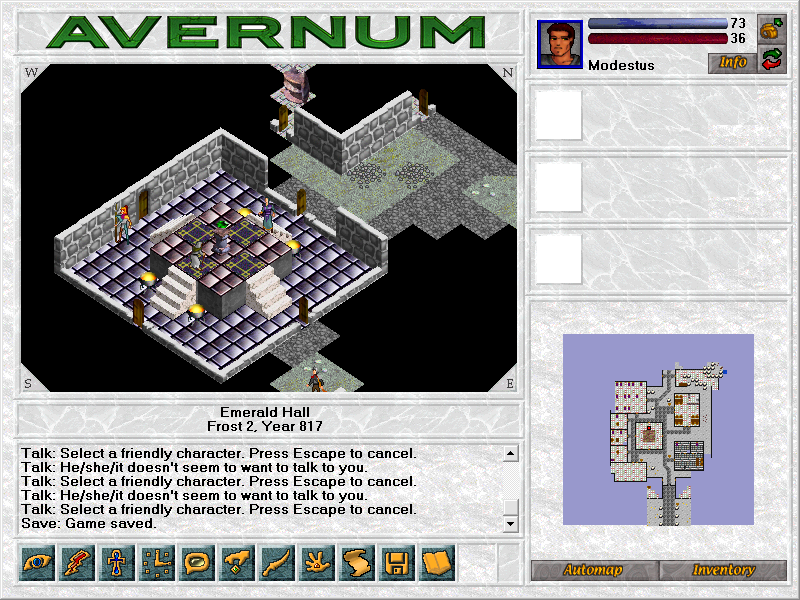
The entire game is set on a square grid. Turn-by-turn the player acts, and the world reacts. Outside of towns, dungeons, and combat, the party occupies a single tile, traversing Avernum and encountering tile events. Otherwise, the party in is Town Mode, and each entity gets its own tile. Outside of combat, all entities get one action per turn. Within combat, Action Points (AP) control how many actions each entity may take. AP use is non-greedy, allowing consecutive actions to drop a character below 0 AP.
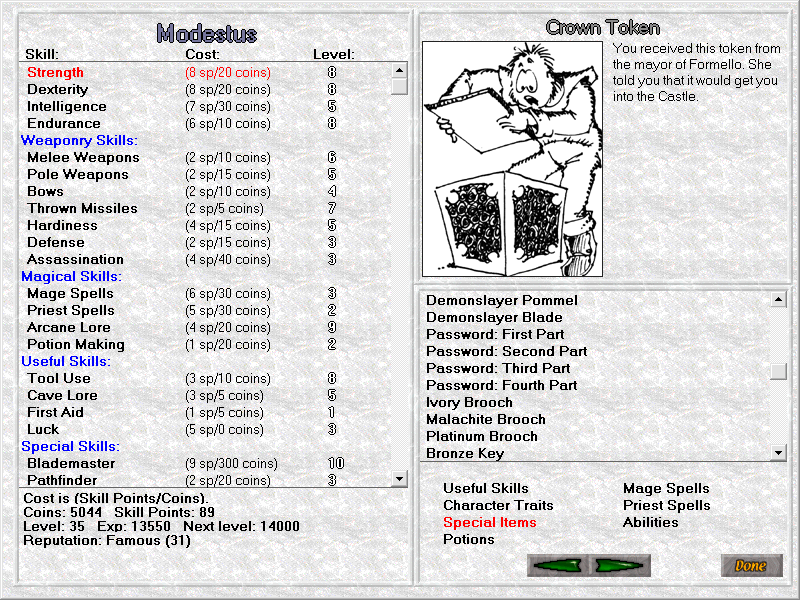
Each character the player controls is built from a list of skills, attributes, traits, and other information. This information is found on the character screen, and each entry is accompanied with a blurb and graphic. The graphics for these items are done by Phil Foglio, and each of the approximately 70 sketches is excellent. There are skills covering categories from weapons proficiency, to arcane ability, as well as tool usage and cave lore. Each character also has 4 attributes along the traditional axes- Strength, Dexterity, Intelligence, and Endurance. Players may also have traits that confer a bonus or malus, and a corresponding shift in level accumulation. This is just a sample of what is available, and the game is quite transparent about which skills and attributes affect others.
In line with the concise graphics comes the primary method of exposition. Avernum is a text heavy game. Nearly all descriptions and dialogue and explanatory information come from text boxes. As an avid reader, I like this. For those who do not like to read, or have difficulty translating words into vivid internal scenery, this could be a breaking point. There is very little handholding in this game, graphical or otherwise. The lone concession in this is a button that records the current text box to your journal for later perusal.
Progression is fairly non-linear, with a general trend from NE Avernum, to S Avernum, up to NW Avernum. There is significant backtracking for many of the quests, and a progress gating system I would describe as simple, but robust and flexible. Many areas are gated with some combination of monsters, locked doors, and terrain features. A sampling of these gates include:
- Terrain hazards that hurt the player, but may be bypassed with a spell
- Barriers that block progress unless a spell is used (gated behind a side quest) or a rare and expensive magical item is expended
- Monsters of varied difficulty throughout a dungeon
- Party skill barriers (explained later on)
The Good
There is always a reward in exploration and talking to NPCs, in either quests, hints, lore or loot. The NPCs without anything useful to say will outright refuse to talk to you. Those who do talk to you are worth it in nearly all cases. There is a smattering of NPCs who are maybe less worth talking to. They will repeat information you already have, or exist to fulfill some sort of joke. When in town, always schmooze a little at the bar. Much of the complexity of Avernum’s lore is found in this dialogue, and in at least one instance the player can discover that their actions have consequences. There are so many quests and people to help out. The sheer number of these adventures in turn provides the player with many ways to approach problems big and small. There are three main quests, several more major quests, and all draws the player’s story out over dozens of hours of gameplay.
The Not So Good
Avernum’s quest system is a fairly low-level affair. Go here, go there, kill something, get an item, whatever. The dungeon holding the MacGuffin will be gated, there will be monsters and traps and whatever else. The exposition can help ease things along at the end of the day, that’s just how RPGs are. Quest rewards are often poor. Many times the player earns only enough coin to buy a few potions. Sometimes the reward is only thanks, sometimes not even that. As itinerant ragamuffins, you don’t seem to command much respect, or particularly good pay. For at least one quest, however, the reward far outstrips the effort required. I won’t spoil anything here, but make sure you get the necklace back for the mayor of Formello.
Being a turn-based game, one that is player centric, the rest of the world cannot move outside of combat mode if you don’t move. Within combat mode this is not a problem, but there is a host of effects and afflictions that can ruin your fun. Sleep, slow, paralysis, charm and summon spells are all freakishly annoying in the first Avernum title. Sleep prevents a character from acting, slow reduces initiative and causes skipped turns. Paralysis is a death sentence. Charm and summon spells are annoying in their own way. More on those later.
Finally, inventory is not particularly graceful. Items sort themselves and cannot be re-arranged. When the party’s inventory is full, and the party gets a new item, such as from a quest or encounter, the item vanishes into the ether. It doesn’t drop to the ground, doesn’t stay with the quest giver, all that happens is the console window lets you know your inventory is full, and too bad.
Solo-Specific Quirks
For this playthrough of Avernum I elected to diverge from the recomenneded way to play and created a party of one. A minor generalist with enough arcane knowledge for a few buff spells, and tons of melee ability. The key advantage to playing this way is that I could engage in combat easily without entering combat mode. This will negate slow and bind debuffs, while opening the player up to a different type of pain.
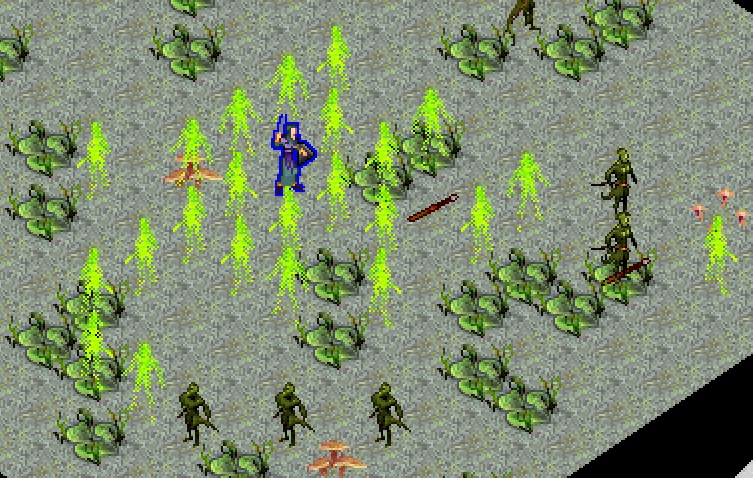
When in combat, sleep and paralysis make you skip your turn. Outside of combat, it softlocks the game. Without being able to move, enemies in turn cannot move, and time in game stops. Paralysis on a single character is essentially a death sentence as damage stacks up with your character being unable to respond. Charm, especially from the gremlin monsters in southern Avernum, has an animation that takes approximately two seconds. Gremlins come in groups of 9-13, which means that when you are very unlucky, your character will get hit with 20-50 of the shimmering rays they fire. This takes minutes per turn, making any battle with gremlins stretch out for ridiculous amounts of time. By far the worst monsters in the game. Summoned creatures are the least painful, but the most annoying. They are universally weak, and exist purely to fill tiles and prevent the character from moving. With a maximum of three attacks per turn, certain combinations of enemies and terrain can quickly grind combat to a standstill.
The worst part of a solo run however, are party skill checks. The most common are spellbooks, but there are checks that cover other skills. Spellbooks are hidden around the world and hold the knowledge that unlocks the strongest version of a spell. In order to get this knowledge, there is a skill threshold that is based on the total amount of said skill in the entire party. In a solo run, there is no party, just the one character. This makes any spellbooks past the first few ridiculously expensive. Those gates I mentioned earlier? You’re locked out if one of them requires one of the highest-level spells.
This review included a lot of negativity, with far more discussion of what was poor, and not so much of what was excellent. This isn't because the game is bad, but the baseline I am working from is one that places Avernum in high esteem. This excellence makes the not so good parts jarringly obvious, and glosses over qualities that would draw adulation when found in other games. With all of this information, I feel like I have enough to answer my initial question.
Did Avernum Do My Memory Justice?
Avernum was fantastic. I had so much fun playing through it again and often found myself so deeply immersed into the game that I forgot to take notes. Amazing. Fantastic. Go play it. The entire six game series is available on Good Old Games for very little money.
Links:
Avernum, the Complete Saga on GOG
Harehunter's Avernum Hint Site
Mike Middleton's Avernum Hint Website